On 22 May 2010, a programmer in Florida paid 10,000 bitcoins for two pizzas. It was the first time anyone bought something real with Bitcoin.
At the time, those coins were worth about $41. Hold that number in your head.
By the end of this article you will understand why a string of computer code became one of the most talked-about assets in the world, and why its price can fall by half without anything "breaking".
⏱ Reading time: about 9 minutes
What you'll learn:
• What Bitcoin really is, explained with a shared notebook
• Why there will never be more than 21 million bitcoins
• The biggest risks, and how beginners can start safely
First, a quick guess
Those 10,000 pizza bitcoins: what were they worth in early November 2026, when one bitcoin cost about $78,500?
- A) About $78,500
- B) About $7.85 million
- C) About $785 million
- D) About $7.85 billion
Keep your answer in mind. We will come back to it.
What is Bitcoin? The shared notebook
Imagine a class where everyone keeps an identical notebook. Every time someone pays someone else, the whole class writes it down in their own copy.
Nobody can secretly change a page, because everyone else's notebooks would disagree. There is no teacher in charge, yet everyone agrees on who owns what.
That is Bitcoin. The "notebook" is called the blockchain, and instead of a class it is copied on tens of thousands of computers around the world. It was launched in January 2009 by an anonymous creator using the name Satoshi Nakamoto.
In one sentence: Bitcoin is digital money recorded in a public notebook that no single bank, company or government controls.
How new bitcoins are made: a lottery every 10 minutes
About every 10 minutes, a new "page" (a block) is added to the notebook. Computers around the world race to solve a hard maths puzzle for the right to add it. This race is called mining.
The winner gets brand-new bitcoins as a reward. Think of it as a lottery where buying more tickets means running more computers and paying more for electricity.
Here's the catch: the reward is cut in half roughly every four years. This is called the halving.
Year |
Reward per block |
Bitcoins created per day (about) |
2009 |
50 BTC |
7,200 |
2012 |
25 BTC |
3,600 |
2016 |
12.5 BTC |
1,800 |
2020 |
6.25 BTC |
900 |
2024 |
3.125 BTC |
450 |
around 2028 |
1.5625 BTC |
225 |
In one sentence: new bitcoins come from mining, and the halving makes them twice as hard to come by every four years.
Why there will never be more than 21 million
Imagine a gold mine that becomes half as productive every four years. You keep digging, but each year you find less, until you are scraping dust.
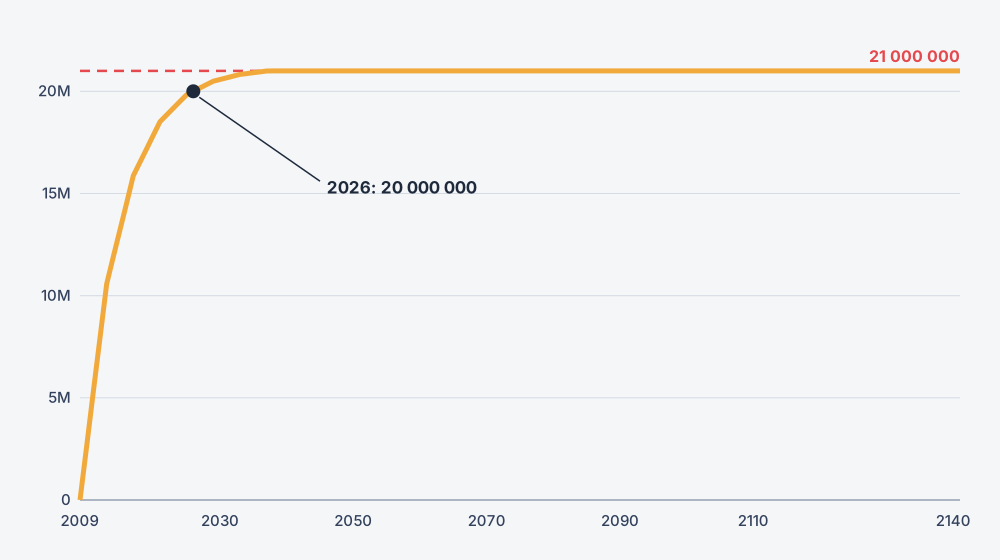
Bitcoin works the same way, by design. The halvings add up to a hard limit of 21 million coins. In 2026 the 20 millionth bitcoin was mined, so more than 95% already exists. The last tiny fractions will only appear around the year 2140.
Now, back to our guess. 10,000 bitcoins × $78,500 = $785 million, so the answer is C. Two pizzas, worth more than a skyscraper.
Why the huge rise? Mostly scarcity plus demand: a fixed supply meets more and more buyers, from individuals to big investment funds, which in the US have been allowed to offer Bitcoin funds (ETFs) since 2024.
❌ Common misconception: "Bitcoin is too expensive, I can't afford one."
✅ Reality: one bitcoin divides into 100 million tiny units called satoshis. You can buy €10 worth, just like you can buy a slice of pizza instead of the whole thing.
In one sentence: Bitcoin's supply is fixed at 21 million, which is the main reason people call it "digital gold".
Wallets and keys: your mailbox
A Bitcoin wallet works like a mailbox. Your address is the slot: you can share it, and anyone can drop bitcoin in. Your private key is the only key that opens the box.
Lose the key, and nobody can open the box for you: not a bank, not a support team, not Satoshi. Share the key, and whoever has it can empty your box.
That is why experienced users repeat: "Not your keys, not your coins." If an exchange holds your bitcoin, you are trusting that company to hold the key for you.
❌ Common misconception: "Bitcoin is anonymous."
✅ Reality: every transaction is public in the notebook forever. Addresses don't show names, but exchanges in the EU must check your identity, so payments can often be traced.
In one sentence: whoever holds the private key owns the bitcoin, and Bitcoin payments cannot be reversed.
The rollercoaster: why the price swings so much
Bitcoin's price is set only by what buyers and sellers agree on. It has no profits, no interest and no central bank behind it, so mood and news can move it fast.
On 6 October 2025 one bitcoin reached a record of about $126,080. By mid-2026 it had dropped to around $60,000. In early November 2026 it was about $78,500, still roughly 38% below the peak.
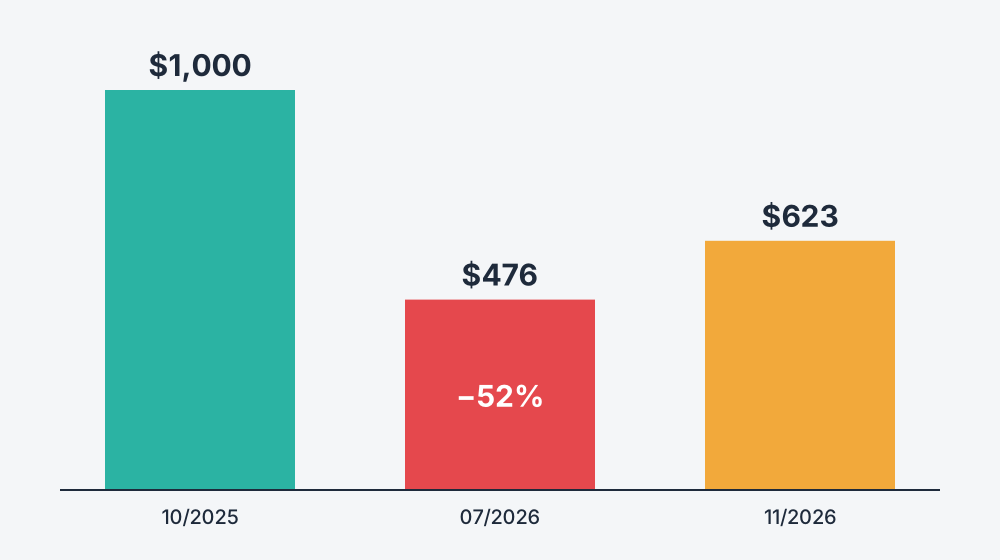
But it gets worse before it gets better: after a 52% drop you don't need +52% to recover. You need +110%, because you are climbing back from a smaller base.
Question |
Bitcoin |
Euro in a bank |
Gold |
Who controls it? |
Nobody: a network of computers |
The European Central Bank |
Nobody, but it must be mined and stored |
Can more be created? |
No, fixed at 21 million |
Yes |
Yes, slowly |
Can a payment be reversed? |
No |
Often, yes |
Not applicable |
Typical price swings |
Very large |
Small (loses value to inflation) |
Medium |
In one sentence: Bitcoin can rise and fall by half within a year, so only invest money you can leave untouched for years.
How to start safely: 6 simple rules
- Build your emergency fund first. Money you may need soon doesn't belong in Bitcoin.
- Keep it small. For most beginners, crypto is a small slice of their investments, not the whole pie.
- Use a licensed platform. In the EU, crypto platforms need a licence under the MiCA rules. Check before you sign up.
- Buy a little at a time. A fixed amount every month (for example €50) smooths out the rollercoaster.
- Protect your account. Turn on two-factor authentication, and consider a hardware wallet for larger amounts.
- Ignore promises of guaranteed returns. Anyone who guarantees Bitcoin profits is very likely a scammer.
⚠️ Risk note: Bitcoin is highly volatile and you can lose a large part or all of your money. It is not protected by any deposit guarantee. Profits are usually taxable. This article is for education only and is not financial advice.
Key takeaways
- Bitcoin is digital money recorded in a public notebook (the blockchain) that no one controls.
- New bitcoins come from mining, and the halving cuts the reward every four years.
- There will never be more than 21 million, and over 95% already exist.
- Whoever holds the private key owns the coins, and payments can't be reversed.
- The price can fall by half in months: invest only what you can leave untouched for years.
Keep learning
Want to see how a crypto platform works in practice, or why people worry about money losing value? Start here:
- Crypto.com Review 2026: Staking, Yield and the Crypto Card Explained Simply
- What Is Inflation? The Silent Thief in Your Wallet, Explained Simply
Data checked on 2 November 2026. Sources: CoinGecko price via Analytics Insight (2 Nov 2026) · CryptoTicker, record high of October 2025 · Crypto Briefing, 20 million bitcoins mined · CoinDesk, the final million bitcoins · Bitcoin white paper (2008)
Test yourself
Three questions to check what you learned. Click an answer.
-
Question 1Every four years the halving cuts the mining reward in half, as in April 2024 (from 6.25 to 3.125 BTC). What does it change directly?
-
Question 2You put $1,000 into bitcoin at the record high of about $126,000. Months later the price is about $60,000. Roughly what is your investment worth?
-
Question 3You send bitcoin to the wrong address by mistake. What can you usually do?
Please note: Investing involves risk, including the loss of your capital. Past performance does not guarantee future results. Content on Financial Testament is for educational purposes only and is not financial advice. Some links on this site are referral links. If you sign up through them, we may earn a commission or bonus at no extra cost to you. We only recommend platforms we have used or reviewed.


