
Imagine a thief who takes €3.80 out of every €100 you own, every single year. He never breaks a window. He never leaves fingerprints. And what he does is completely legal.
That thief is called inflation, and in September 2026 it was moving at exactly that speed across the eurozone. In Bulgaria, it was taking €5.60.
By the end of this article you will know the one number that shows whether your savings are really growing. Most people look at the wrong one.
⏱ Reading time: about 8 minutes What you'll learn: • What inflation really is, explained with a pizza • Why prices are rising fast again in 2026 • How to tell if your money is growing or quietly shrinking
First, a quick guess
If prices rise by 3% a year, how many years until your money buys only half of what it buys today?
- A) 50 years
- B) 33 years
- C) 24 years
- D) 10 years
Keep your answer in mind. We will come back to it.
What is inflation? The pizza explanation
Imagine a school fair with exactly 10 pizzas for sale, sold at auction. Every student has €5 of pocket money, so a pizza goes for about €5.
Now imagine every student suddenly gets €10 instead. There are still only 10 pizzas. The bids go up, and soon a pizza costs €10. Nothing about the pizza changed. Your money just got weaker.
That is inflation: the general rise in prices over time, which means each euro buys a little less than before.
How it is measured: the shopping basket
Statisticians fill an imaginary shopping basket with what a typical household buys: bread, rent, fuel, electricity, haircuts, phone bills. Every month they check what that basket costs.
If the basket cost €100 last September and €103.80 this September, inflation is 3.8%. In the eurozone this measure is called the HICP. In the United States it is the CPI.
In one sentence: inflation is not about one thing getting expensive, it is about your money losing power across almost everything.
Why are prices rising again in 2026?
Inflation usually has one of three causes. Here they are, with an everyday picture for each.
Cause |
Everyday picture |
Real example |
Demand-pull |
More money chasing the same pizzas |
Post-pandemic spending in 2021–2022 |
Cost-push |
The bakery's oven fuel gets expensive, so bread does too |
Energy prices in the eurozone up 18.9% in a year (Sept 2026) |
Expectations |
Everyone raises prices now because they expect higher prices later |
Workers asking for bigger raises, shops raising prices in advance |
2026 is mainly a cost-push story. The war in the Middle East has disrupted oil and gas supplies, and energy alone added 1.71 percentage points to the eurozone's 3.8% inflation in September.
Here's the catch: energy is inside almost everything. Trucks deliver food, factories run on electricity, and planes burn fuel. In Bulgaria, transport prices were up 16.4% in a year.
The ECB raised interest rates in 2026 even though higher rates can't pump more oil. The goal is to stop the third cause, expectations, before a temporary shock becomes permanent.
In one sentence: 2026 inflation started with energy, and central banks are fighting to stop it from spreading everywhere else.
Is a little inflation bad?
Think of inflation like body temperature. Around 36.6°C is healthy. 39°C is a fever. But 34°C, too cold, is also dangerous.
The European Central Bank aims for 2% a year, its "healthy temperature." The opposite of inflation, falling prices (deflation), sounds great but can freeze an economy: people delay buying because things will be cheaper tomorrow, companies sell less, and jobs disappear.
❌ Common misconception: "Inflation is falling, so prices will go down." ✅ Reality: if inflation drops from 6% to 3%, prices are still rising, just more slowly. Prices almost never go back to where they were.
In one sentence: a little inflation is normal and even healthy, while too much (or too little) causes real damage.
What inflation does to your savings
Remember the number most people get wrong? Here it is.
The interest rate your bank shows you is the nominal return. What really matters is the real return: what is left after inflation.
Real return ≈ interest rate − inflation
Example: you keep €10,000 in a savings account paying 2%. After a year you have €10,200. But with 3.8% inflation, those €10,200 buy only what €9,827 bought a year ago. You "earned" €200 and still got poorer.
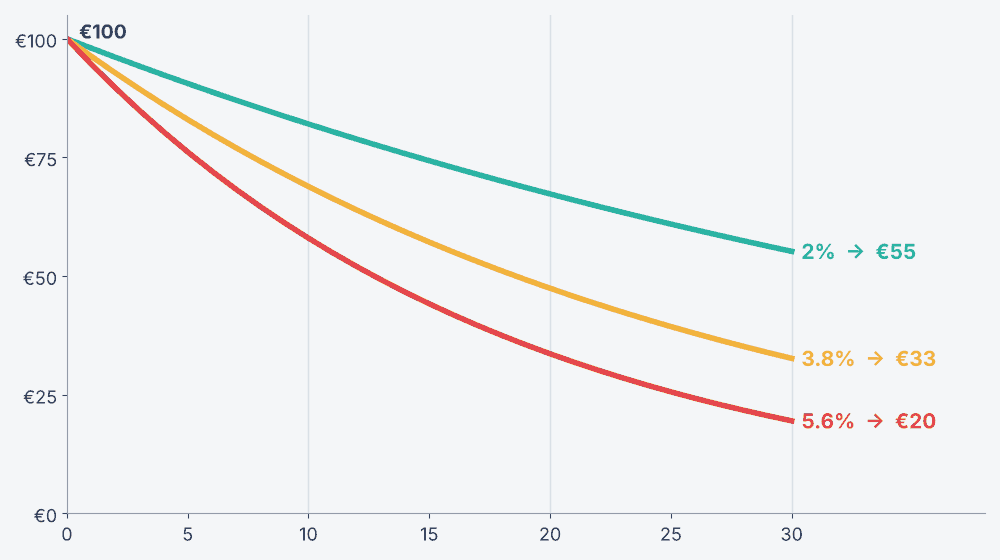
The Rule of 72 (and the answer to our guess)
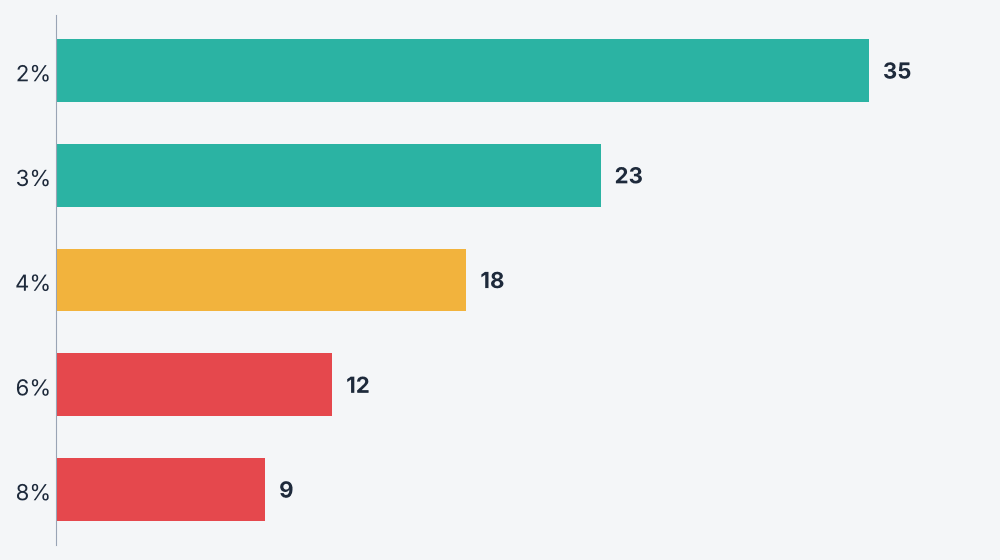
Want a mental shortcut? Divide 72 by the inflation rate. The result is roughly how many years it takes for prices to double, which means your money buys half as much.
At 3% inflation: 72 ÷ 3 = 24 years. So the answer to our opening guess is C) 24 years (23.4 to be exact). If you picked 50 or 33, you are in good company: our brains badly underestimate how fast small percentages compound.
In one sentence: always compare your return with inflation, because a positive interest rate can still mean you are losing money.
Who wins and who loses from inflation?
Inflation doesn't hit everyone equally. It quietly moves value from some people to others.
Usually loses |
Usually wins (or suffers less) |
Cash kept under the mattress or in 0% accounts |
Borrowers with a fixed-rate loan, who repay with "cheaper" euros |
Fixed incomes that don't rise with prices |
Owners of assets that tend to rise with prices, like property or businesses |
Lenders at fixed rates set before inflation jumped |
Workers who can negotiate raises above inflation |
But it gets better: once you know which side of the table you are on, you can start moving toward the other one.
How to protect your money (without panicking)
There is no magic shield, but these principles have helped people historically:
- Know your real return. Check what your savings earn after inflation, not before.
- Keep an emergency fund, but only that, in cash. About 3 to 6 months of expenses, ideally in the best-paying safe account you can find.
- Let long-term money work. Over long periods, diversified investments such as broad stock index funds have historically beaten inflation, though with ups and downs along the way.
- Consider inflation-linked bonds, whose payments rise with inflation.
- Invest in yourself. A new skill or a raise is the most direct inflation hedge there is.
Some investors also use P2P lending for higher interest, but higher returns always come with higher risk. If that interests you, read our comparison of the best P2P lending platforms in Europe first.
⚠️ Risk note: all investments can lose value, and past returns don't guarantee future ones. This article is for education only and is not financial advice.
Key takeaways
- Inflation means your money buys less over time. It was 3.8% in the eurozone and 5.6% in Bulgaria in September 2026.
- The 2026 surge is mainly driven by energy (cost-push), linked to the Middle East conflict.
- Always look at your real return: interest minus inflation.
- Rule of 72: 72 ÷ inflation = years until your money buys half as much.
- Falling inflation does not mean falling prices.
Keep learning
If you are thinking about how to make your money grow faster than inflation, start with these:
- Best P2P Lending Platforms in Europe 2026: 12 Platforms Compared
- What Is P2P Lending? How You Can Be the Bank, Explained Simply
Data checked on 2 November 2026. Sources: Eurostat, euro area inflation September 2026 · Bulgarian National Statistical Institute, September 2026 · ECB, "The new energy shock" (May 2026) · ECB monetary policy strategy
Test yourself
Three questions to check what you learned. Click an answer.
-
Question 1Your savings account pays 4% a year. Inflation is 5.6%, like in Bulgaria in September 2026. After one year, your purchasing power has:
-
Question 2Inflation in a country falls from 6% to 3%. What happens to prices?
-
Question 3Energy prices jump 19% because of a war that disrupts oil and gas supply. The central bank still raises interest rates. What is the main reason?
Please note: Investing involves risk, including the loss of your capital. Past performance does not guarantee future results. Content on Financial Testament is for educational purposes only and is not financial advice. Some links on this site are referral links. If you sign up through them, we may earn a commission or bonus at no extra cost to you. We only recommend platforms we have used or reviewed.


